About The Conformist
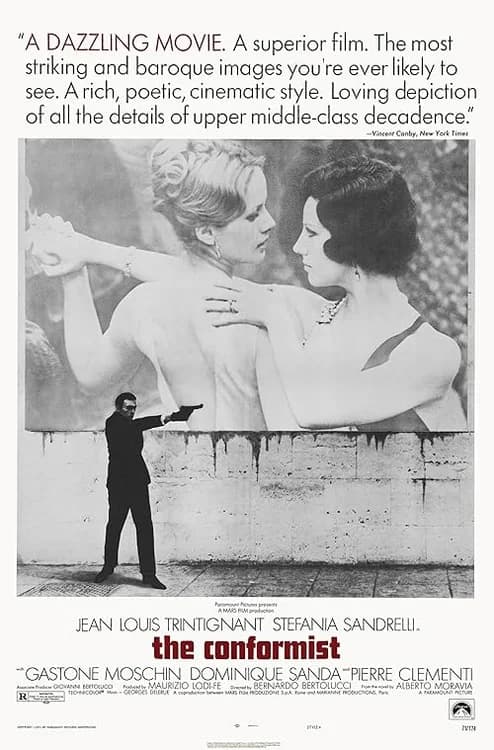
Bernardo Bertolucci's 'The Conformist' (1970) is a landmark of Italian cinema and a searing psychological portrait of moral compromise. The film follows Marcello Clerici, a man desperate for normality in Mussolini's Italy, who agrees to become a fascist secret agent. His defining mission: to travel to Paris and orchestrate the assassination of his former philosophy professor, now a leading anti-fascist dissident. As Marcello navigates a world of shadowy politics and personal betrayal, the film masterfully explores the allure of conformity and the corruption of the soul.
Jean-Louis Trintignant delivers a career-defining performance as the hollow, desperate Marcello, whose quest for a 'normal' life leads him into profound darkness. Bertolucci's direction is breathtaking, with Vittorio Storaro's cinematography creating some of the most iconic and visually sumptuous images in film history. The use of light, shadow, and grandiose architecture becomes a character in itself, reflecting the opulent decay of the fascist era and Marcello's internal fragmentation.
More than a political thriller, 'The Conformist' is a profound meditation on guilt, memory, and identity. Its nonlinear narrative weaves together past trauma and present action, revealing how personal weakness can be exploited by totalitarian systems. For viewers, it remains an essential watch not only for its historical insight but for its timeless examination of the individual's struggle within oppressive societal structures. The film's artistic influence is immeasurable, and its powerful, unsettling beauty makes it a compelling and necessary cinematic experience.
Jean-Louis Trintignant delivers a career-defining performance as the hollow, desperate Marcello, whose quest for a 'normal' life leads him into profound darkness. Bertolucci's direction is breathtaking, with Vittorio Storaro's cinematography creating some of the most iconic and visually sumptuous images in film history. The use of light, shadow, and grandiose architecture becomes a character in itself, reflecting the opulent decay of the fascist era and Marcello's internal fragmentation.
More than a political thriller, 'The Conformist' is a profound meditation on guilt, memory, and identity. Its nonlinear narrative weaves together past trauma and present action, revealing how personal weakness can be exploited by totalitarian systems. For viewers, it remains an essential watch not only for its historical insight but for its timeless examination of the individual's struggle within oppressive societal structures. The film's artistic influence is immeasurable, and its powerful, unsettling beauty makes it a compelling and necessary cinematic experience.