About The 400 Blows
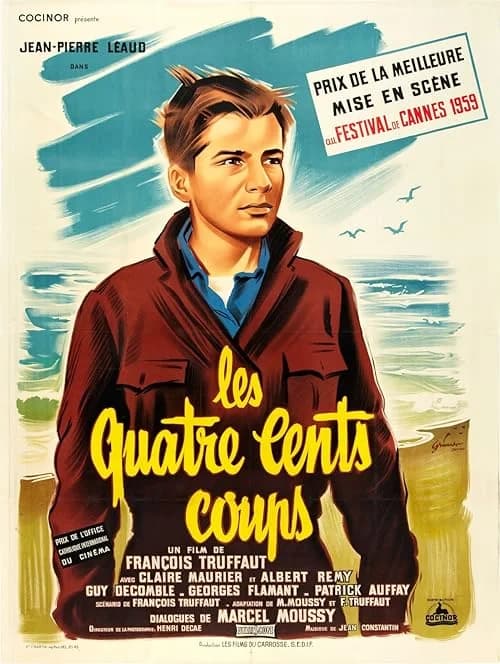
François Truffaut's groundbreaking 1959 film 'The 400 Blows' (original French title 'Les Quatre Cents Coups') stands as a cornerstone of French New Wave cinema and one of the most authentic portrayals of adolescence ever captured on film. The story follows 12-year-old Antoine Doinel (brilliantly played by Jean-Pierre Léaud), a Parisian boy neglected by his self-absorbed parents and misunderstood by the rigid educational system. As he seeks escape from his unhappy home and school life, Antoine drifts into minor delinquencies—playing hooky, stealing a typewriter, telling small lies—that gradually escalate, leading to his placement in a juvenile observation center.
Truffaut's semi-autobiographical direction is both compassionate and unsentimental, capturing the restless energy of youth with remarkable authenticity. The film's famous final sequence—a continuous tracking shot of Antoine running toward the sea, ending with his iconic frozen gaze directly into the camera—remains one of cinema's most powerful and ambiguous conclusions. Léaud's naturalistic performance, largely improvised, gives the film its raw emotional core, making Antoine's journey feel painfully real rather than melodramatic.
Viewers should watch 'The 400 Blows' not only for its historical significance in revolutionizing cinematic storytelling but for its timeless exploration of childhood alienation. Truffaut's use of location shooting in Paris, jump cuts, and voice-over narration broke from traditional filmmaking conventions, creating an intimate, immediate connection with Antoine's perspective. The film launched both Truffaut's career and the French New Wave movement, while beginning a five-film collaboration between the director and Léaud that spanned twenty years. More than six decades later, its portrayal of institutional failure and a child's search for freedom remains profoundly moving and relevant.
Truffaut's semi-autobiographical direction is both compassionate and unsentimental, capturing the restless energy of youth with remarkable authenticity. The film's famous final sequence—a continuous tracking shot of Antoine running toward the sea, ending with his iconic frozen gaze directly into the camera—remains one of cinema's most powerful and ambiguous conclusions. Léaud's naturalistic performance, largely improvised, gives the film its raw emotional core, making Antoine's journey feel painfully real rather than melodramatic.
Viewers should watch 'The 400 Blows' not only for its historical significance in revolutionizing cinematic storytelling but for its timeless exploration of childhood alienation. Truffaut's use of location shooting in Paris, jump cuts, and voice-over narration broke from traditional filmmaking conventions, creating an intimate, immediate connection with Antoine's perspective. The film launched both Truffaut's career and the French New Wave movement, while beginning a five-film collaboration between the director and Léaud that spanned twenty years. More than six decades later, its portrayal of institutional failure and a child's search for freedom remains profoundly moving and relevant.